Key takeaways
- In most brands no single team owns subscription: the CRO team owns the widget, and the founder or email agency carries the revenue.
- Every subscription decision should aim at 12-month LTV, because cancel rate, save rate and take rate can each improve while the business gets worse.
- For brands below $20m, subscription growth beats retention, because most subscribers are still on orders one and two.
A brand asked me last week, “so how would you grow our subscription revenue?”
I gave the usual answer. Audit, offer, flows, cancel flow.
Then I thought about it properly. The deliverables are not the answer. Any agency can list those.
What you believe drives the strategy, not the other way around.
So here are ours. Twelve hills I will die on.
Who owns this
1. Nobody owns subscription. Your email agency cannot fix it.
In most brands the founder or the email agency carries subscription revenue. The CRO team owns the widget. Nobody owns the whole thing.
Email will not touch the widget. CRO will not touch the communication. So the offer, the portal, the cancel page and the retry logic sit in the gap between them.
Subscription needs all three at once. Communication, financial sense, and business sense.
What we measure
2. Everything points at 12-month LTV.
Cancel rate, save rate, take rate, retention rate. Each one can be won while the business gets worse.
Every decision should point at increasing lifetime value inside 12 months.
3. Retention’s job is to shorten payback, not to lengthen lifetime.
A subscriber who stays six months and clears CAC at month four gives you two months of profit. One who stays three months and clears at month one gives you the same, and frees the cash three months sooner.
Past six months, payback stops being a number you manage and starts being a number you hope for.
4. Below $20m, subscription growth beats retention.
Take rate applies to everyone who buys. Order-three retention applies only to those who got that far. On a small base most subscribers are still sitting on orders one and two, so acquisition moves the number and retention moves a slice of it.
What it adds up to
5. The P&L is the scoreboard.
LTV and payback land in cash flow. Everything else is an input, not a target. Attributed revenue is the easiest number in the account to make look good, and open rates are easier still.
6. Investors buy retention, not growth.
They have capital. They can buy customers themselves. What they cannot buy is a cohort curve that holds. Retention, LTV and churn are the numbers they go through first.
How it gets built
7. Offer beats message.
Most brands arrive with a flow problem. Nine times out of ten it is an offer problem wearing a flow costume. You cannot email someone into keeping a subscription that ships more than they can use.
8. Consumption sets the frequency.
Units per pack divided by daily dose. If the longest option in your dropdown outruns how fast the product gets used, the churn was scheduled at checkout.
9. Control every message for the first 90 days. Then loosen it.
No campaign calendar, no promo blasts, nothing competing with the one thing a new subscriber has to do, which is use what they bought.
10. No habit, no subscriber.
The unopened box is the whole problem in one picture. They liked the product. They meant to start. It went on a shelf.
11. Gifts beat discounts.
A discount comes off every renewal after it. A gift costs you once.
The forever discount is the most expensive habit a subscription brand can form, because you taught the subscriber to wait for the next one.
Pick a gift they will use daily, a shaker, a tin, an organiser, and it becomes the cue that keeps the routine running. A discount sits on the invoice. A gift sits on the counter.
12. Transparency is not a tactic.
The hidden cancel link buys one more charge and costs you the review. We build the cancel path, the pause path and payment recovery to be found.
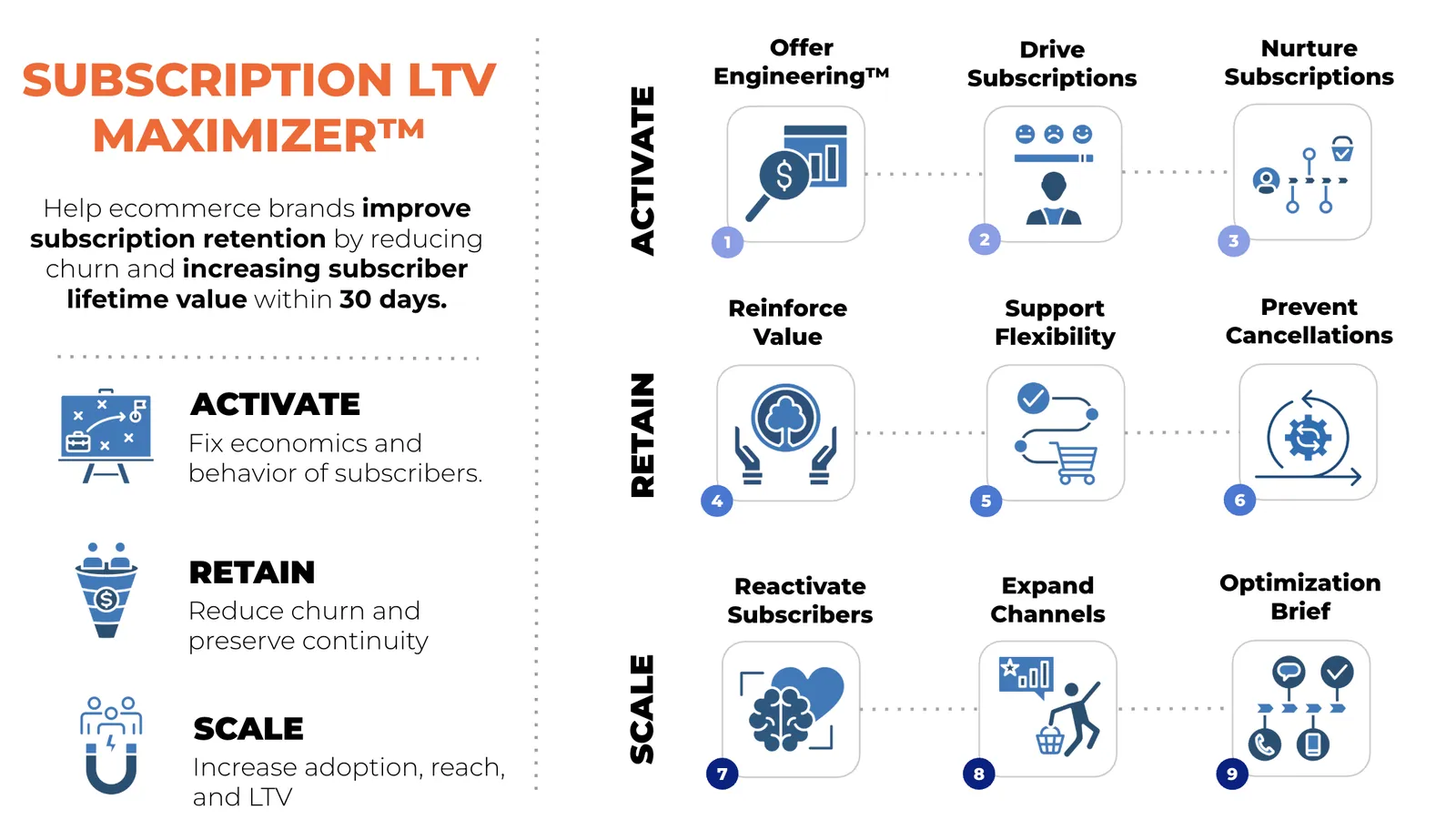
Every one of these is a step in the framework. Nine steps, three phases, 30 days.
If you believe in the same things, we are probably a good fit. Book a call and let’s work together.
One email a week on subscription retention: the numbers, the strategy, and what to fix first.

Rahi Jain
Rahi Jain is a subscription LTV specialist who helps DTC brands maximize their LTV from subscriptions.
More about Rahi