Key takeaways
- Subscription brands should recover CAC by order 2, inside 31 days on monthly billing and inside 91 days on quarterly billing.
- The accurate way to calculate CAC payback is by cohort, since CAC divided by contribution margin per order ignores cancellations.
- Faster CAC payback beats higher LTV for growth: a 60-day payback buys six customers a year with the same cash, and 180 days buys two.
What will make you reach $100m faster?
Higher LTV or Faster CAC Payback Period.
No doubt. Faster CAC payback period. Always.
Get your money back in 60 days, and the same cash buys six customers a year.
Take 180 days, and it buys two, even if each of those two is worth more.
6 customers vs 2 customers.
Same spend, same margin, a third of the growth.
Short payback means you can outbid competitors, test more, survive a bad month, and fund the next cohort out of the last one instead of out of a credit line.
So what should yours be?
Someone asked me last week what good payback looks like. Here is the number I gave.
If you bill monthly, by order 2. That is inside 31 days.
If you bill quarterly, by order 2. That is inside 91 days.
For most, it’s somewhere between 31 and 91 days.
Anything more than that is trouble.
6-9 months will slow you down considerably.
Even if you are funded.
Fast payback is permission to spend.
Churn ranks subscribers backwards
A subscriber who churns at order 4 can still be profitable, if the cost came back by order 2.
A subscriber who stays a year and never covers acquisition is a slow loss.
IM8 has a $581 LTV and still takes 12 months to break even due to their celebrity endorsements.
Naked Paper moved a bulk option to checkout. First-order AOV rose 63% and CAC came back 20% faster. Churn never moved. The business got healthier anyway.
Churn tells you who left. Payback tells you if you can keep buying customers.
To be on the same page, how’s CAC payback period calculated?
Simple analysis is CAC divided by contribution margin per order, but that doesn’t take in the cancellations.
Real is Cohort payback period like –
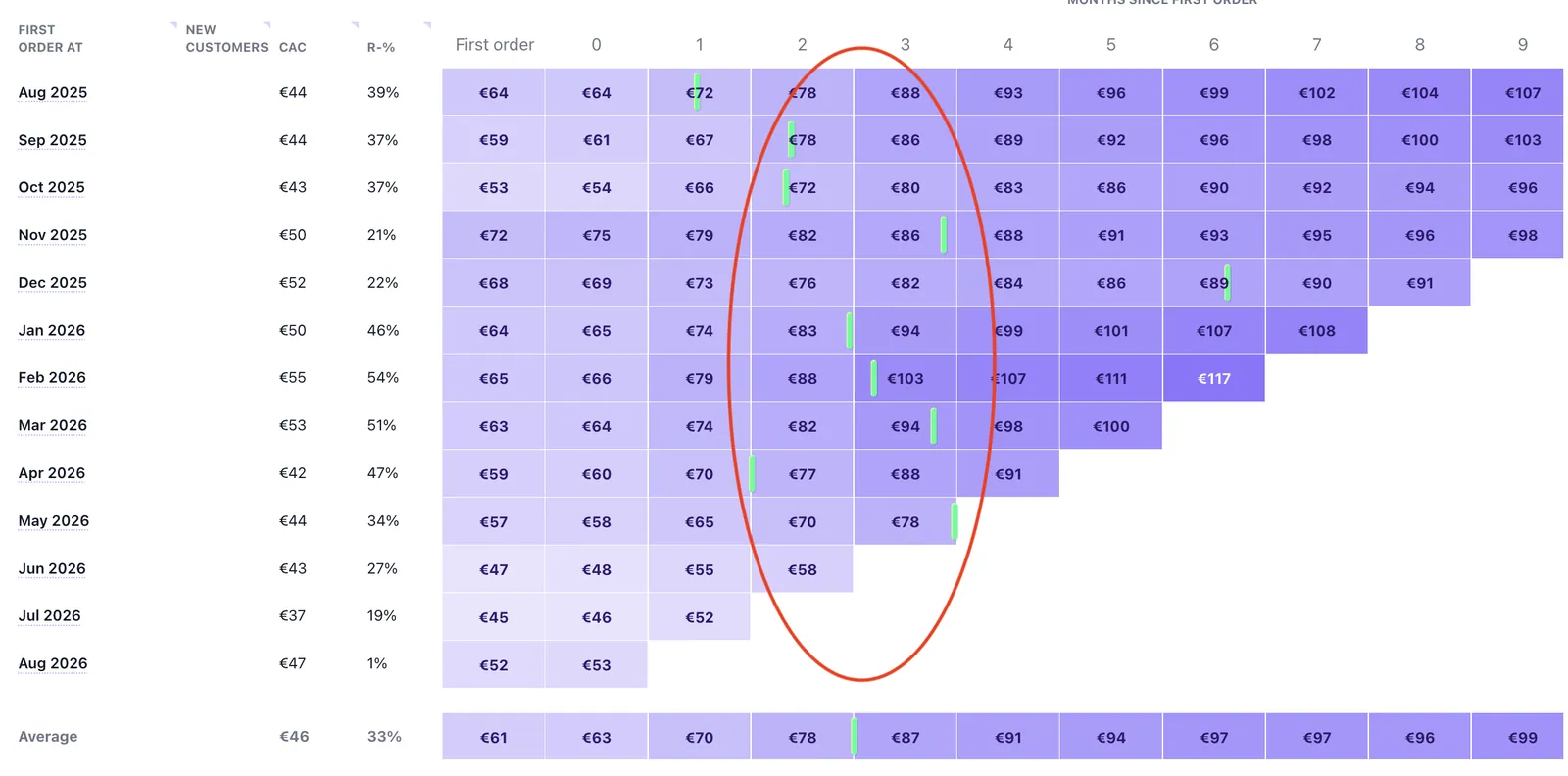
Green line is payback period
Each cohort becomes profitable when cohort sales margin exceeds your cost of customer acquisition (CAC).
In the above example, most orders are becoming profitable from months 1 to 3.
It’s 2nd order profitability depending on the monthly or quarterly subscriptions.
Why cohort, because you need to take care of cancellations.
The per-order version assumes everybody survives. Nobody does.
Ten ways to pull the date in
Payback moves five ways. A bigger first order, cash pulled forward after checkout, more margin per order, fewer people dying before they repay, or a lower CAC to begin with.
Make the first order bigger
- 3-month supply as the dominant option on the widget. Not a dropdown entry. Visually first, priced per day so the saving is obvious. The only lever that can pay you back on day one.
- Build-a-box subscription. More units per acquisition without more acquisition.
- Sell the household, not the person. Price and pack for a couple or a family rather than an individual. Same CAC, two or three units per order.
Pull cash forward after checkout
- Post-purchase add-on before order 1 ships. Same window, smaller ask.
- Customer portal add-on carousel. Subscribers attach items to the next order at zero acquisition cost.
Raise margin per order
- Cut the first-order discount.
- Move gift value from order 1 to orders 2 and 3.
Stop losing people before they repay
- Payment recovery in the first 60 days.
- Order-2 survival. Payback lives in orders one to three, exactly where the cohort thins. Anyone who leaves at order 2 was a marketing expense.
Lower the CAC itself
- Raise take rate instead of buying more traffic. Same ad spend converting more buyers into subscribers lowers effective subscription CAC without touching the media plan.
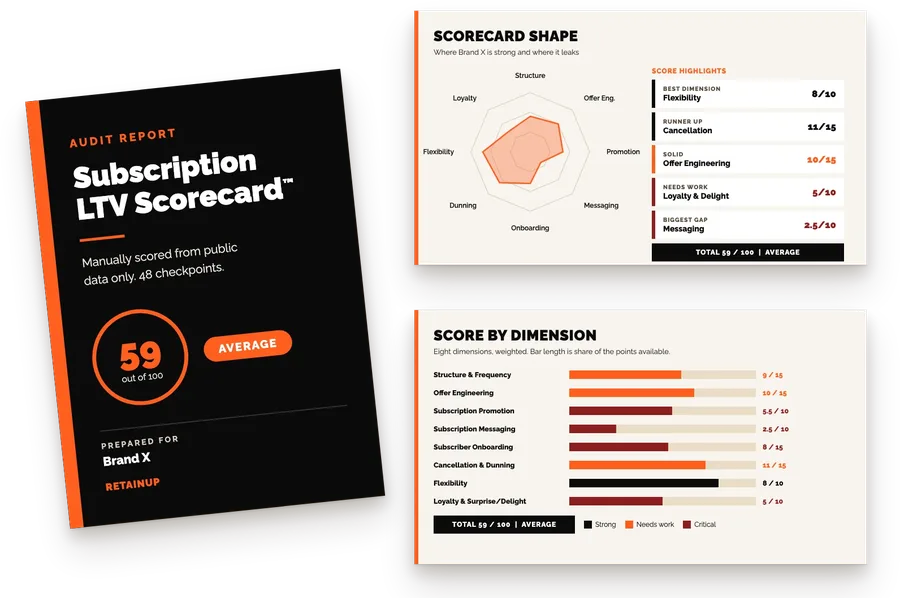
Full mechanics on each, with the math, in the Subscription LTV Maximizer.
Every one of these shows up in the P&L. That is the only place a subscription program is allowed to be judged.
One email a week on subscription retention: the numbers, the strategy, and what to fix first.

Rahi Jain
Rahi Jain is a subscription LTV specialist who helps DTC brands maximize their LTV from subscriptions.
More about Rahi